


When we talk about explosive atmospheres, we refer to an area affected by one or more factors that may generate a potential explosion risk. In many cases, these areas must be equipped with ATEX‑certified electrical equipment.
To equip an area or a machine exposed to explosion risk, it is essential to know the classification of the location. This classification is determined based on the explosion risk assessment. With this assessment and depending on the technical requirement, we can select the most suitable equipment, taking into account both safety and technical requirements.
This article analyses locations and equipment, not the substances that originate the explosion risk. Its interest lies in linking the classification of the location with the selection of equipment.
To describe locations in explosive atmospheres, the designations Class I and Class II are used
Class I: locations with explosion risk due to gases, vapours or mists.
Locations must be assessed in terms of risks and, according to the result of this evaluation, classified as:
Class II: locations with explosion risk due to dust.
As in the previous case, Class II locations must undergo a risk assessment. Based on this assessment, the areas are classified as:
If we focus on equipment intended for use in explosive atmospheres, according to the EN60079‑0 standard they are classified into three groups.
Group I: equipment intended for use in mines susceptible to firedamp1.
1Firedamp is a flammable and lethal gas, mainly composed of methane, found in coal mines. It forms together with coal and when mixed with air can cause violent explosions when in contact with an ignition source. In addition to its explosive potential, it is dangerous because it can displace oxygen and cause asphyxiation.
Group II: equipment intended for use in areas with explosion risk due to gases and vapours, excluding mines susceptible to firedamp.
This group has the following subdivisions:
IIA (reference: propane)
IIB (reference: ethylene)
IIC (reference: hydrogen)
See list of gases that can generate an explosive atmosphere: https://www.inpratex.com/en/list-of-gases-vapours-that-may-generate-an-explosive-atmosphere/
Group III: equipment intended for use in areas with explosion risk due to combustible dust other than mines susceptible to firedamp.
With the divisions:
IIIA (combustible particles2),
IIIB (non‑conductive dust)
IIIC (conductive dust)
2The difference between combustible particles and dust lies in their classification within the ATEX framework. In this context, combustible particles are considered to be fibres and larger particles such as textile fibres or wood shavings.
According to Directive 2014/34/EU Annex I, equipment intended for use in potentially explosive atmospheres is classified into two categories for Group I equipment and three categories for Group II equipment
Group I:
Category M 1: very high level of protection
Category M 2: high level of protection
Group II:
Category 1: very high level of protection (zones 0/20)
Category 2: high level of protection (zones 1/21)
Category 3: normal level of protection (zones 2/22)
Note: Directive 2014/34/EU does not refer to Group III as the EN60079‑0 standard does in its most recent version.
When referring to gases, vapours and combustible dusts, in summary we can say that locations are organised into two classes (Class I and Class II), while equipment is grouped into three groups (Groups I, II and III).
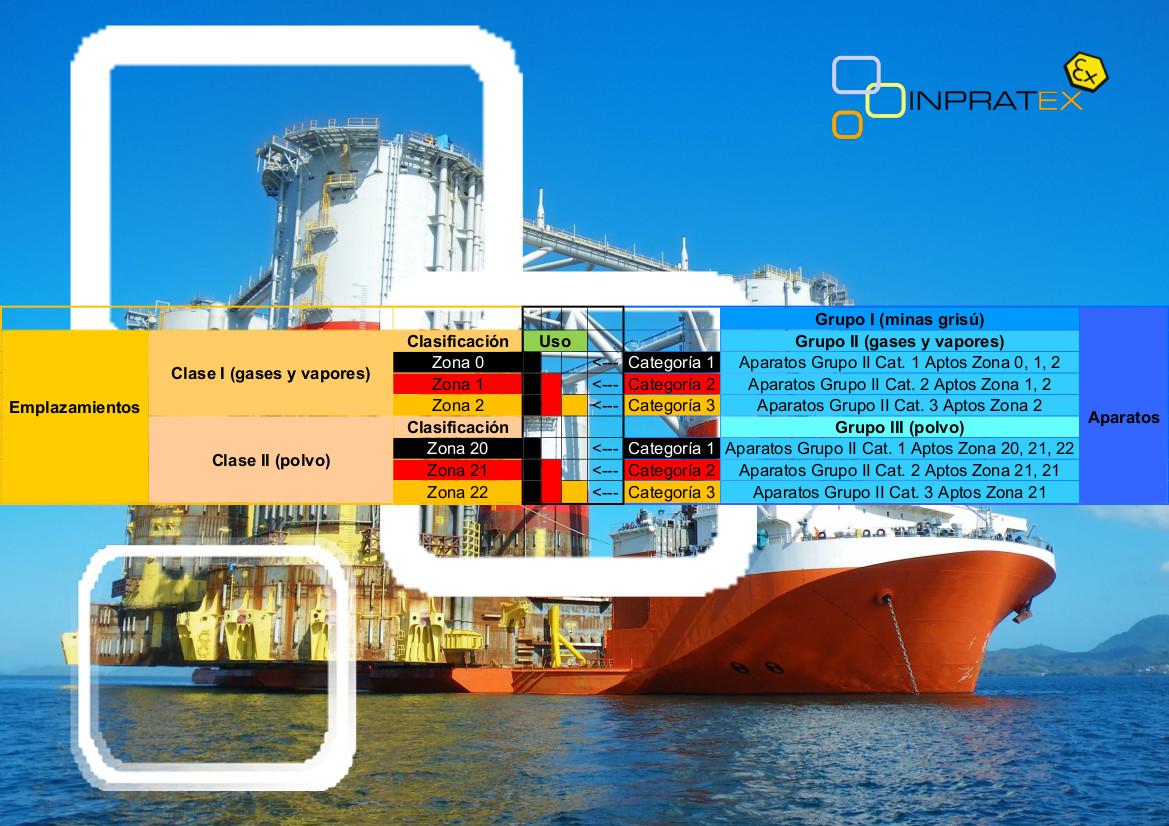
The equipment of Group I is classified into two categories, while that of Groups II and III is classified into three categories. The meeting point between locations and equipment are the zones: locations are classified as zone 0, 1 and 2 (for gases and vapours) and zone 20, 21 and 22 (for combustible dust).
The equipment categories, depending on their level of protection, determine in which zone they can be safely used.
| Group I (fire-damp mines) | |||||||||
| Locations | Class I (gases and vapours) | Classification | Use | Group II (gases and vapours) | Devices | ||||
| Zone 0 | <— | Category 1 | Group II, Category 1 equipment suitable for Zones 0, 1 and 2 | ||||||
| Zone 1 | <— | Category 2 | Group II, Category 2 equipment suitable for Zones 1 and 2 | ||||||
| Zone 2 | <— | Category 3 | Group II, Category 3 appliances suitable for Zone 2 | ||||||
| Class II (dust) | Classification | Group III (dust) | |||||||
| Zone 20 | <— | Category 1 | Group II, Category 1 equipment suitable for Zones 20, 21 and 22 | ||||||
| Zone 21 | <— | Category 2 | Group II, Category 2 devices suitable for Zone 21, 21 | ||||||
| Zone 22 | <— | Category 3 | Group II, Category 3 appliances suitable for Zone 22 | ||||||
In an installation in Eibar, 10 luminaires of the sealed‑batten type, 28W, suitable for Class I and Category 3 for explosive atmospheres are required.
With the information received (Class I, Cat 3) a lot of critical information required for the correct selection of equipment is missing. However, it is possible to answer the request leaving a reasonable gap due to technical impossibility, which will require a second review by the prescriber, since the definition is incomplete.
Class I: indicates that equipment is required for use in the presence of gases or vapours
Category 3: the equipment must be suitable for use in zone 2.
With the information received we know that we are dealing with an explosive atmosphere caused by gases and vapours, present rarely or never.
In this typical specification example we still need to know the gas or vapour causing the explosion risk in order to determine the requirements regarding gas group and temperature class that must be covered by the luminaires selected.
In an installation in Eibar, 10 ATEX luminaires of the sealed‑batten type, 28W, suitable for Class I and Category 3 are required. For gas group IIB and temperature range T1.
In this second example we have all the necessary data to supply the correct luminaires without margin for error.
As in the previous case, when we are told the luminaires must be suitable for Class I, we automatically know they must be suitable for gases and vapours. Category 3 means the luminaires are for use in zone 2. The gas/vapour causing the explosive atmosphere is not specified, but the reference to IIB indicates the gas group involved. In addition, the temperature class is specified as T1. Therefore, we need a luminaire for zone 2 with a marking at least for gas group IIB and a temperature class of at least T1.
A luminaire that meets this requirement is for example the following:
https://www.inpratex.com/en/product/atex-led-light-fittings-series-nd866/
The nD866 series mentioned in the example has the following marking:
II 3G Ex ec IIC T4 Gb
II 3D Ex tc IIIC T80ºC Dc
If we look only at the gas part, we see that the equipment is category 3 for use in zone 2 and can operate with gas group IIC. Therefore, these luminaires can also operate in gas groups IIB and IIA, since these groups are less restrictive than IIC. Regarding temperature class, as the nD866 series is marked T4, it can operate in temperature classes from T1 to T4.
In an installation in Eibar, 10 ATEX luminaires of the sealed‑batten type, 28W, suitable for Class I and Category 3 are required. Possible explosion risk caused by ethanol.
In this case we are in the same situation as example 2, but the gas group and temperature class are not given. Instead, the substance causing the explosion risk is specified. We therefore refer to the following table:
We search for ethanol in the table. The table indicates ethanol belongs to gas group IIA and temperature class T2, which allows us to determine that the nD866 luminaire series is still suitable for operation in an atmosphere caused by ethanol in zone 2.
Sources:
EN60079-0
ITC29-9
Directive 2014/34/UE